
/ Assessment
Physio
Check-Up
A full check of how your body works — when nothing hurts.
Not a “search for disease”. It is a snapshot of your mechanics: it shows a tendency toward injury before the injury happens — and what exactly is holding your results back.
Leave your number — then pick what suits you: Telegram or a call. No commitment.
/ What is included
What the check-up
consists of
01 · Mobility
Range of motion in degrees for every joint and section of the spine: neck, hip, knee, ankle. We compare it with the norm and between sides.
02 · Strength and symmetry
Dynamometry: trunk flexion and extension, hip extension and adduction, knee flexion and extension. A difference of more than 10% between sides is already a risk factor.
03 · Balance and control
Single-leg stance with eyes open and closed, squats on platforms — we watch how weight is distributed and where the body loses control.
04 · Conclusion
We explain in plain words what we found and give you exercises you can do on your own. All measurements go straight into a tablet — you see the numbers during the test, not “by feel”.
/ What it looks like
What you take
home with you
A report with measurements for every block — where you are now, what falls outside the norm and what to do about it.
- range of motion in degrees for every joint — and how far it is from the norm
- the difference between your right and left side in percent
- balance on one leg with eyes open and closed
- weight distribution when squatting on platforms
- a conclusion in plain words: what exactly is holding your movement back
- exercises to do at home with sets and reps
- if needed — physical therapy targeted at the problem area
This is what the report looks like
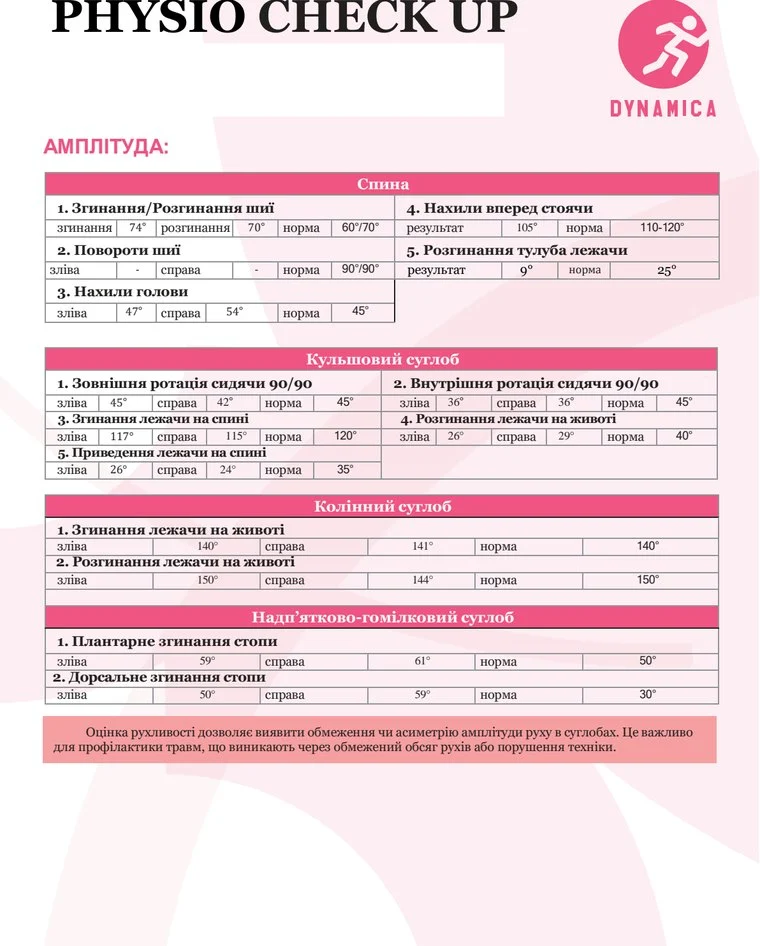
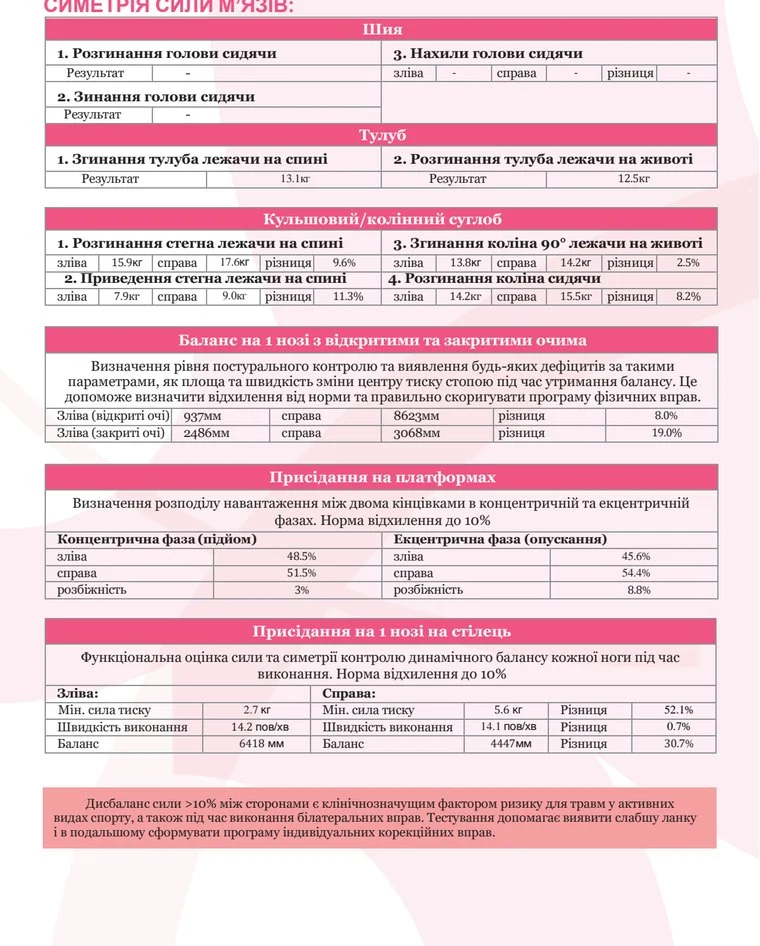
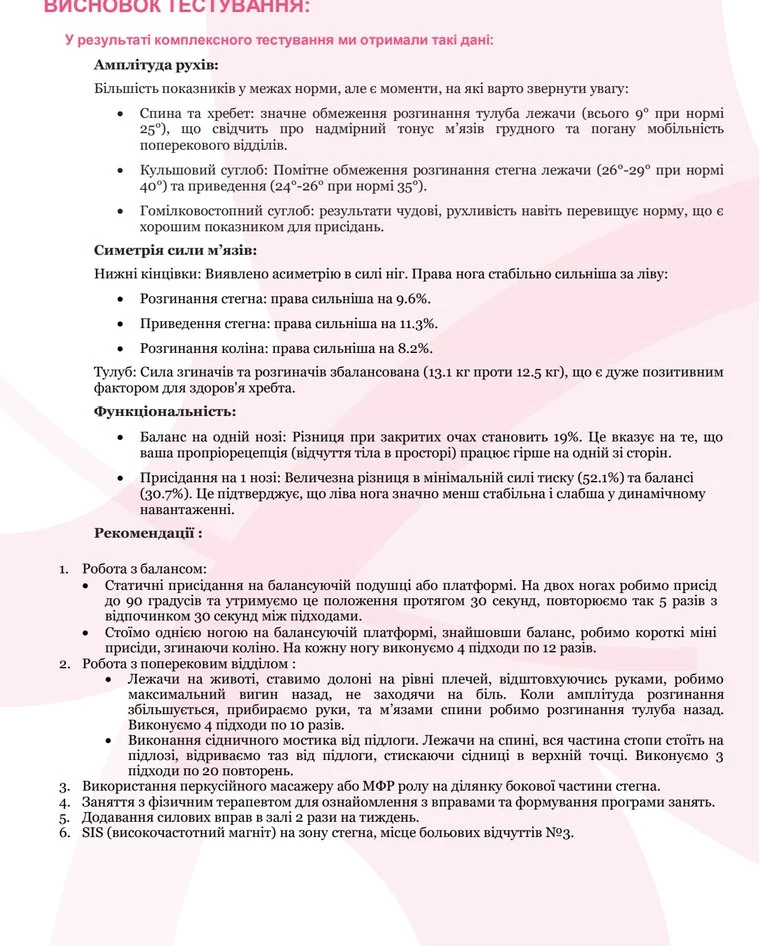
A real report, personal data hidden
- 6A Pyrohova St — a five-minute walk from Universytet metro
- Mon–Fri 08:00–20:00, Sat–Sun 09:00–18:00
/ The difference
How the check-up differs
from a movement assessment
In short: the assessment is for when something hurts or gets in the way. The check-up is for when nothing hurts, but you want to understand what you are living with.
- the assessment focuses on your problem — the check-up looks at the whole body
- it shows a tendency toward injury while the injury has not happened yet
- a side-to-side difference over 10% is already a risk factor, and here you see it in numbers
- it leaves numbers you can come back to in six months
- if something hurts right now — start with a physical therapist consultation
We were among the first in Ukraine to bring in this equipment. What is usually judged by eye is measured here in degrees, kilograms and percent — so an imbalance is visible long before it turns into an injury.
/ Who needs it
Who really needs
a check-up
Most often two kinds of people: those chasing results, and those who want to keep their shape for a long time.
- you train for results and want to add speed or strength
- progress has hit a ceiling and the reason is unclear
- you are preparing for a marathon, a triathlon or a new sport
- you are returning to load after a long break
- nothing hurts, but your body is not what it used to be
- desk job and a feeling that your back is “on its last legs”
- after 40 — when you want to keep your independence for a long time
- you want a baseline so that in six months you can see the progress
Case
A runner was preparing for a half marathon and kept hitting a wall on time. The check-up showed an imbalance: the right glute barely switched on — other muscles were pulling the load. A few weeks of targeted work — and a personal best on the distance.
Why now and not later
What today takes a couple of procedures and a few weeks of exercises becomes, a year from now, serious pain and restricted movement — and sometimes surgery.
It is like a car: a small part drags a bigger one with it, then further down the chain — and it ends not with replacing a bushing but with an overhaul. Or like teeth: removing early decay is cheaper and faster than treating half a jaw later.
The check-up is the entry point into MOVE STRONG. Not only for athletes, but they get the fastest gain from it: you can see which link is holding the result back.
/ The full picture
Together with the
VO₂max test
The check-up shows the mechanics: how the body moves. VO₂max shows the engine: how much reserve you have.
Together they give the full picture.
That is why we offer them as a pair — and that is how people usually take them. Check-up UAH 3,000, VO₂max test UAH 4,000, together UAH 7,000.
Three different entry points — for different needs
Physio Check-Up — when nothing hurts, but you want to understand the mechanics. VO₂max test — your endurance and health reserve. Physical therapist consultation — when something hurts or gets in the way.
/ Hypothesis vs measurement
A chatbot answers on average. We measure yours
Every day someone arrives with an answer already worked out with AI. That is fine — it just has to be checked against your body.
A model sees what the internet says about knee pain in general. About your knee it knows nothing.
- it will not watch you squat, or see where the movement breaks down
- it will not feel which muscle fails to switch on and which one is working for two
- it will not notice that the knee hurts because of your foot or your hip
- it will not measure strength, range and endurance in numbers
- it will not change the plan when your body responds differently than expected
- it is not accountable for the outcome — we are
Come in with your AI hypothesis — bring it along. We will test it and tell you plainly what held up and what did not. Often part of it holds: the direction was right, but the cause sits somewhere else entirely.
/ Team
Who will work with you
Real specialists with medical education — not “just massage”.
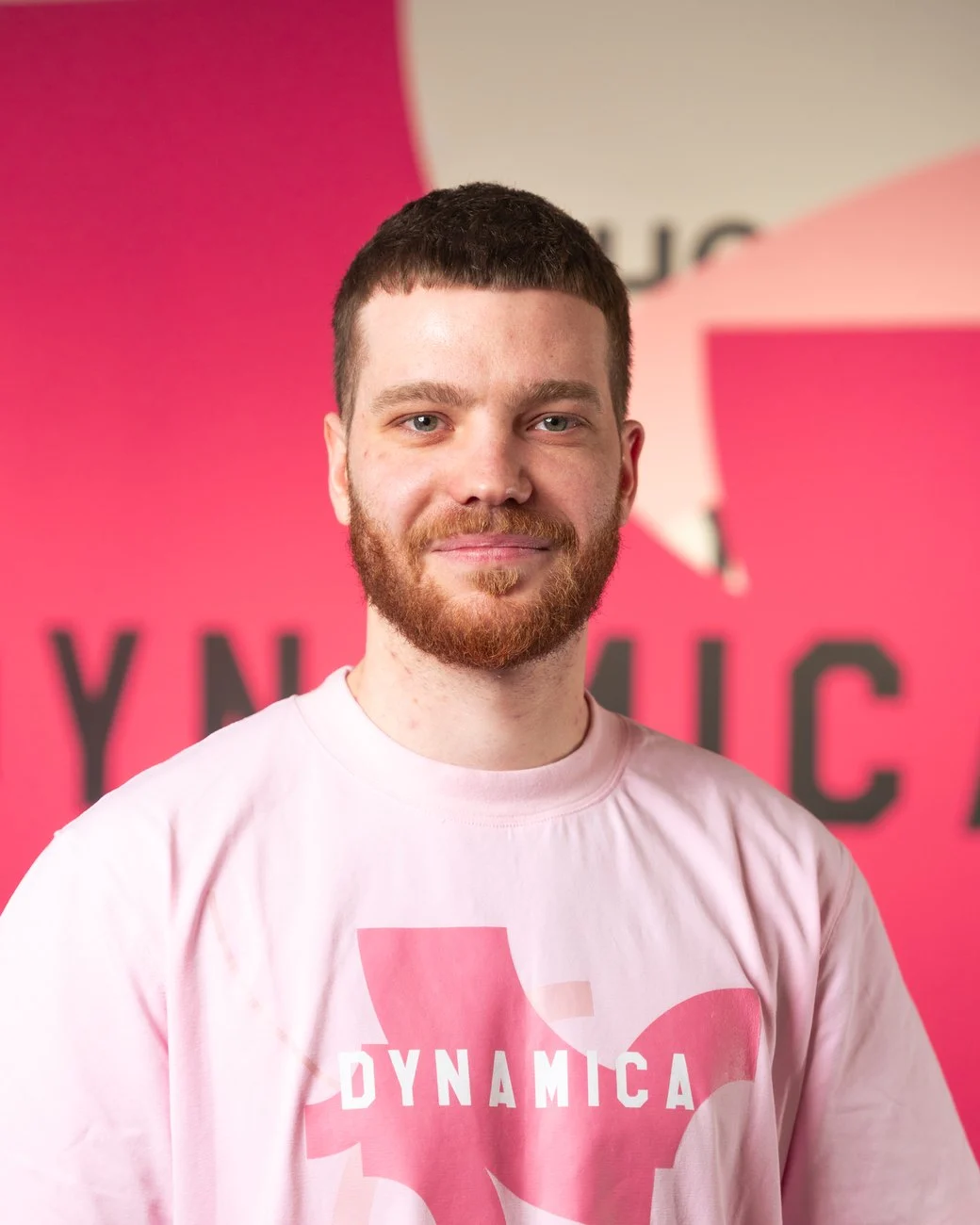 Valerii KutsaiRecovery specialistAfter heavy load, back, stability6 years+
 Mykyta ShutovRecovery specialistKnee, posture, foot · FC Zorya5 years+
 Valeriia CherniiRecovery specialistInjuries, arthrosis, chronic pain4 years+
 Tania HerasymivRecovery specialistRecovery after load, movement after injury4 years+
 Denys SemerikRecovery specialistInjuries, training load, movement2 years+
 Daryna PopovaRecovery specialistBack, shoulders, knees, postnatal recovery4 years+
/ Reviews
What people say about us
“I did the check-up and finally understood where my weak spots are and why something kept hurting. They explained it clearly, with no sales pressure.”
Дмитроa movement assessment“They explained all the possible causes incredibly clearly and simply, and suggested what can be done about it, including exercises worth doing. As a result the pain went away quickly.”
Ірина Шевченкоfound the cause of the pain“The physio check impressed me — a clear analysis of the muscles, and as a result I have a list of exercises for specific muscles.”
Iuliia Chepurkomuscle analysis
/ First step
Find out what you
are living with right now
The check-up does not scare you with diagnoses. It gives you numbers and an understanding of where your body is heading.
Physio Check-Up — UAH 3,000 · 90 min · together with VO₂max UAH 7,000
/ Questions and answers
Frequent questions
How long does it take?+
What should I bring?+
Is this instead of a medical exam?+
Is it worth repeating?+
What about the marathon discount?+

/ Who is responsible for this area
Reviewed by Valeriia Cherniiphysical therapistBogomolets National Medical University · injuries, arthrosis, chronic pain · BTL-Ukraine schoolSpecialist profile →23 September 2026