/ Where it hurts
Does your knee hurt?
It is not always “something tore”. We will bring movement control back.
We work step by step — from removing pain to building strength, under medical supervision.
Leave your number — then pick what suits you: Telegram or a call. No commitment.
/ Signs
What people come in
complaining about
Pain when walking
and especially going down stairs.
Pain when bending
squats, getting up from the couch.
Pain after running
shows up the next day or during the run.
Pain under the knee
or on the inner side.
Swelling
after load or for no reason.
Instability
the knee gives way or clicks.
/ What it means
If your MRI says
“meniscus”
You read “meniscus damage”, “cruciate ligament tear” — and fear appears. We know that state.
- not every injury means surgery
- what matters is assessing joint function under load — that is what determines the strategy
- we do not replace surgery where it is needed
- but we often help avoid it
- there is an orthopedic trauma surgeon on the team — we review MRIs and ultrasounds together
An image shows structure. Decisions are made by function.
/ Who it is for
This is for you if…
- you started running — and the knee began reminding you about itself
- you twisted or hit your knee a year ago, and it is still “not right”
- going down stairs is harder than going up
- you were told “take care of your knee”, but not how exactly
- you are afraid to squat, though you used to do it without thinking
- the MRI has words on it, and nobody explained what to do with them
People who come to us are not athletes — they are people who want to move, sleep and sit normally without pain.
/ The cause
Why the knee hurts
in reality
The knee is part of a kinematic chain.
It is affected by the foot, shin, thigh and pelvis.
The problem is often not in the meniscus but in how load is distributed along the whole leg. The most common causes: tissue overload, loss of stability, poor movement technique, compensations after an old injury, a sudden jump in volume. So we assess the whole leg, not just the painful spot.
What happens,if you do nothing
When the knee hurts, the body adapts: you shift weight to the other leg, change your gait, avoid bending. At first this helps you move without sharp pain. But over time other structures get overloaded — and the problem becomes chronic. Early intervention is much simpler than recovering after years of compensation.
/ First visit
What happens at the first visit
It will not hurt. This is not about enduring, it is about understanding your movement — 90 minutes at a comfortable pace, and you leave with a plan.
We check joint mobility and muscle strength, palpate the area you complain about, take your history and run functional tests.
We try the first exercises and watch how your body responds — without sharp pain.
What exactly is holding the pain, which movement patterns are off, and a clear route forward. No pushing.
/ Proof
What you take
at the first visit
Not an opinion “in words”, but a written report: complaints, examination data in numbers, a conclusion and recommendations. Here are three real ones — different cases.
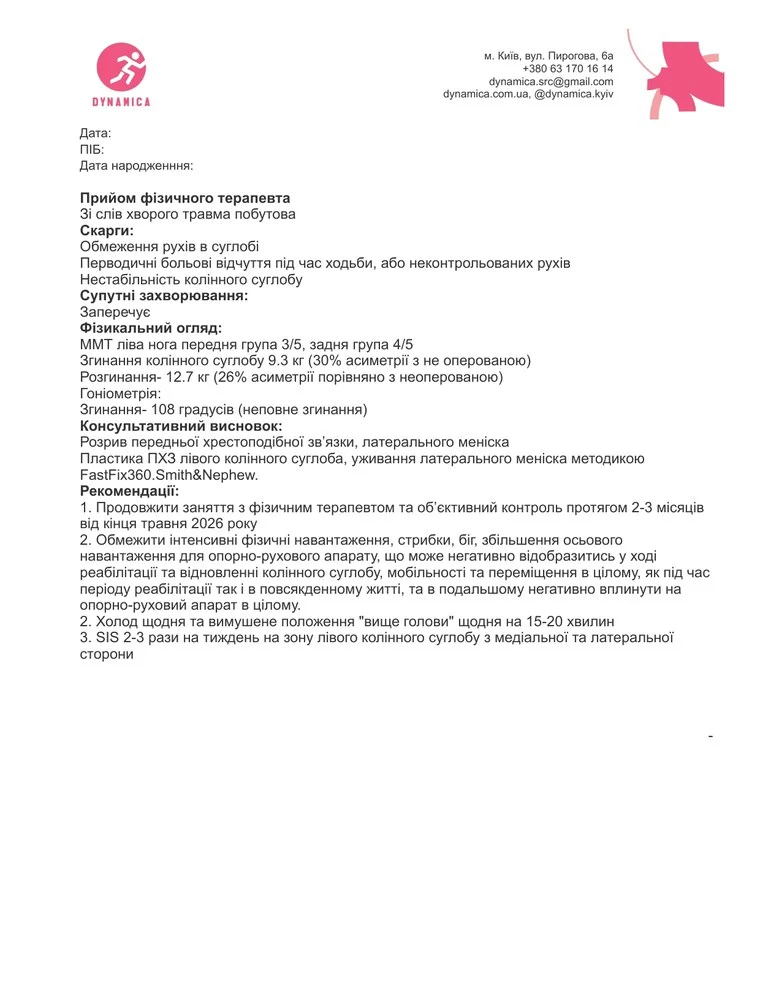
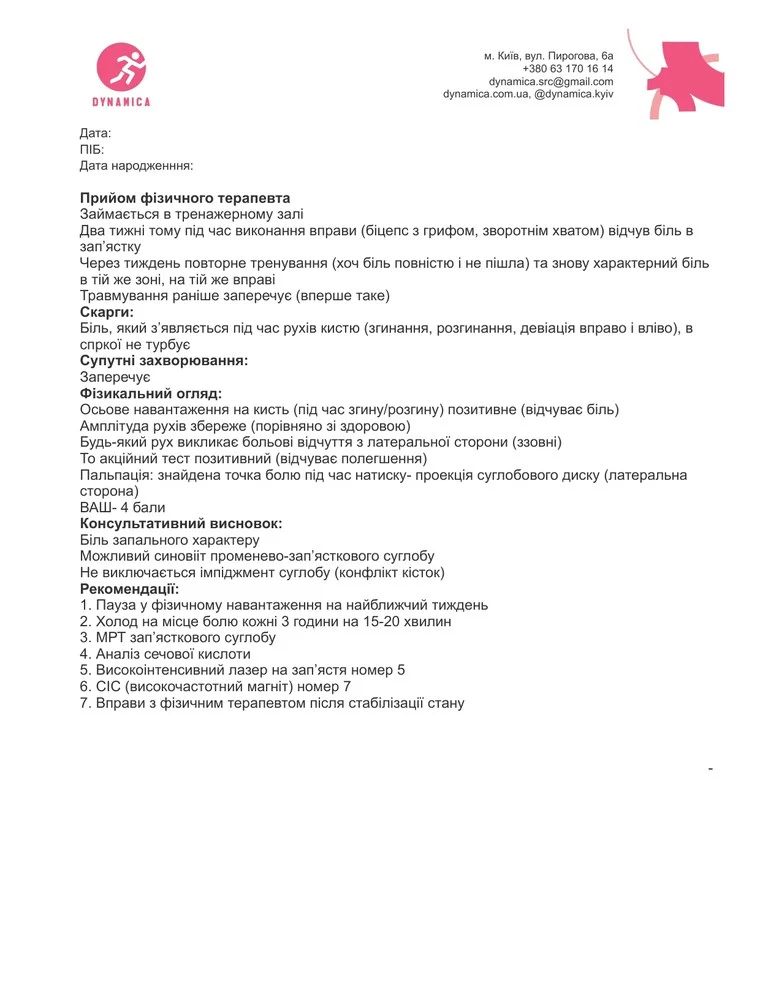
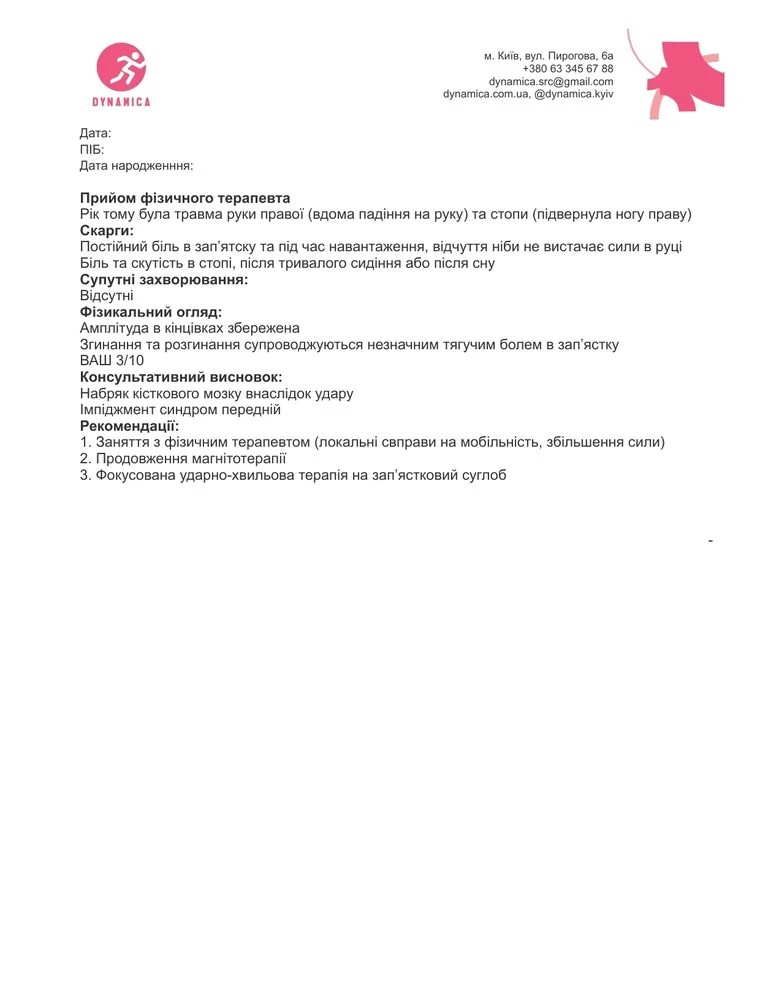
Real reports. Personal data hidden.
/ Recovery route
How we work:
from pain to strength
How long does it take? The first changes in movement control are noticeable within a few weeks. Strength and endurance are months of systematic work. We will be more precise after the assessment.
Stage 01 of 04 · REHAB
Take the load off
First — calm the tissue reaction.
- We assess the joint and how it responds to weight-bearing.
- We reduce swelling and irritation and settle the acute phase.
- Physiotherapy — to lift the barrier and get movement back.
Stage 02 of 04 · MOVE SAFE
Rebuild stability
The knee should move under control, not by luck.
- We switch on the muscles that hold the knee: glutes, quadriceps, calf.
- We remove the compensations picked up while it hurt.
- We restore full flexion and extension.
Stage 03 of 04 · MOVE SMART
Strength and technique
Load goes up — technique does not break down.
- Squats, stairs, getting up from a sofa — we break down the mechanics.
- We correct your gait and running technique.
- We dose volume so there are no setbacks.
Stage 04 of 04 · MOVE STRONG
Full load
The knee handles what you came here for.
- Return to running, the gym or your sport.
- A margin for sharp movements and changes of direction.
- Preventing the pain from coming back — a plan you run yourself.
/ Team
Who will work with you
The knee is handled by those who work with sports injuries and joints.
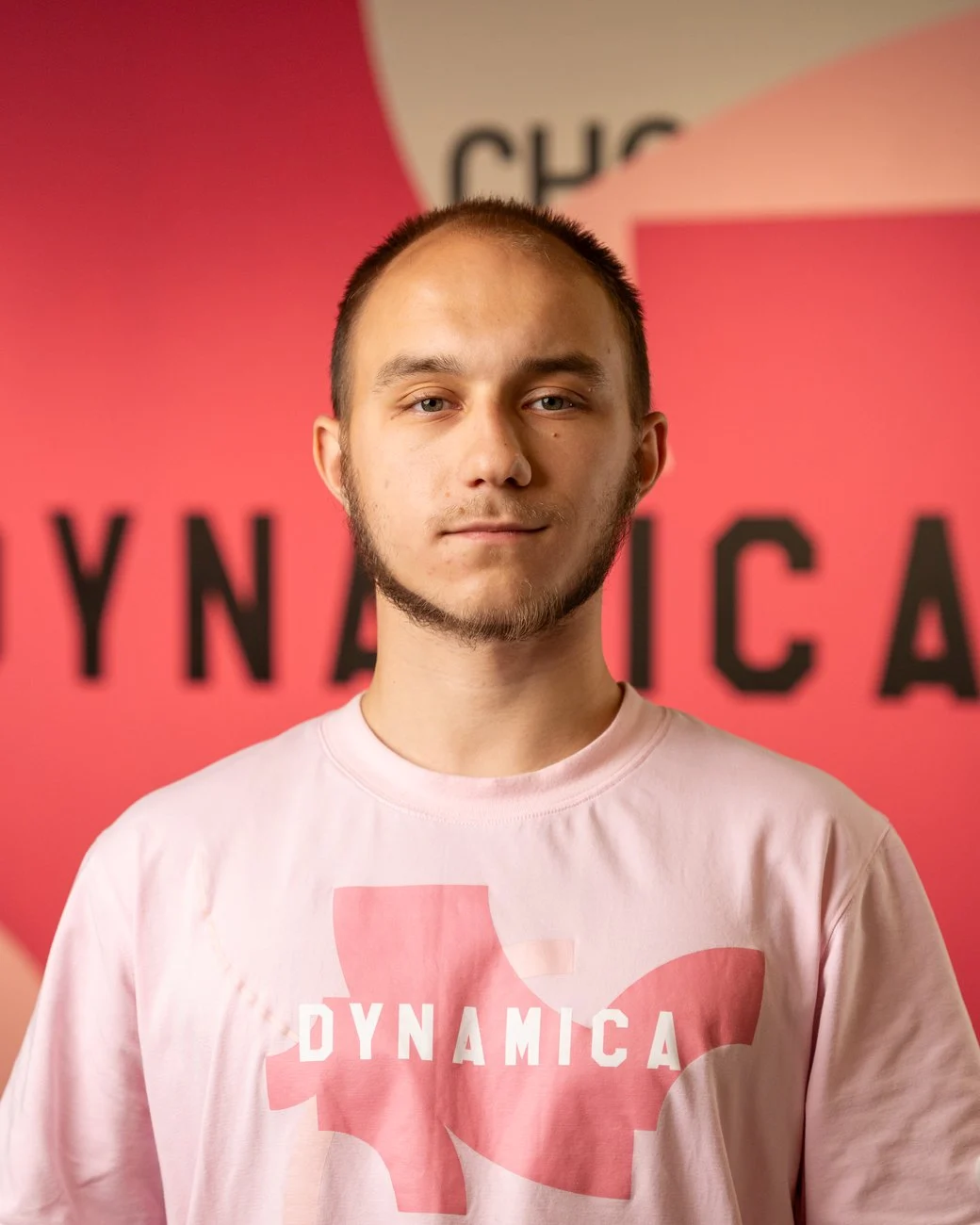 Mykyta ShutovRecovery specialistKnee, posture, foot · FC Zorya5 years+
 Valeriia CherniiRecovery specialistInjuries, arthrosis, chronic pain4 years+
 Daryna PopovaRecovery specialistBack, shoulders, knees, postnatal recovery4 years+
/ Physical therapy
What can help
you get there faster
When the knee is swollen or the pain is sharp, it simply will not bend — and any exercise becomes either impossible or unsafe. The equipment removes that barrier so you can start moving.
This is not a separate course of procedures. Everything works inside the plan — and at the first visit it is included in the price.
Six tools. Which of them you actually need is decided by the physical therapist after the movement assessment.
/ Red flags
When you need a doctor examination
These signs mean you need a doctor first:
/ Reviews
What people say about us
“I am going through rehabilitation after complex knee surgery and I am very happy with the result. The rehab specialist Vlad and the staff are very attentive, they always explain what is being done and why.”
di naknee“I am very grateful to the team of this center for helping me recover after a knee injury. A special big thank you to my physical therapist Mykyta Shutov!”
Даріна Поповаknee“I did ballet for 12 years and injured my knee because of it. On a recommendation I came to Dynamica, where from the first visit I felt an individual approach.”
Олександра Чернійknee“I came to Dynamica because of discomfort in my knee and limited movement.… Now I am actively doing sport again without pain.”
Анастасія Падійknee
/ First step
If your knee hurts —
start with an assessment
The assessment will show what exactly is being overloaded and why. The movement assessment does not commit you to further work.
Movement assessment — UAH 2,000 · sessions after that UAH 1,500
/ Questions and answers
Frequent questions
I have a meniscus tear. Is surgery the only option?+
Not every meniscus injury requires surgery. Many tears are managed conservatively, especially degenerative ones. What decides is not the image itself but how the joint works under load — and that is what we assess.
Can I fully recover after arthroscopy?+
In most cases yes. We work after clearance to move, gradually bringing back range, strength and control. The most noticeable jump is usually in the first 2–3 weeks of work.
Can I run if my knee hurts?+
It depends on the cause. Sometimes running has to be removed temporarily, sometimes the volume and technique need to change. At the assessment we determine what exactly is overloaded and what to do about running right now.
I have arthrosis. Am I allowed to load it at all?+
You are allowed and you should — the question is dosage. Movement feeds joint cartilage. The task is to find a load that strengthens rather than destroys.
Do I need an MRI before the visit?+
Not necessarily. If you have one — bring it. If not — do not get one specially: after the examination we will say whether imaging is needed and which type would be informative.
How long does recovery after an ACL tear take?+
It is a long distance — months, not weeks, and it depends on whether there was surgery. We give an exact forecast after the assessment, with intermediate checkpoints.
Why does my knee keep clicking?+
The sound on its own is not a diagnosis. Clicking without pain, swelling or loss of range usually just means the joint is working. What concerns us is different: clicking that comes with pain, that started after an injury, or that comes with a locking feeling — the knee jams or will not fully straighten. Then we look at it closely.

/ Who is responsible for this area
Reviewed by Mykyta Shutovrehabilitation and physical therapistNUPESU, physical therapy · knee, posture, footSpecialist profile →19 September 2026