
/ Where it hurts
Does your hand
or wrist hurt?
This is not just “overload”. It is a signal that the arm is working inefficiently.
We work step by step — from removing pain to building strength, under medical supervision.
Leave your number — then pick what suits you: Telegram or a call. No commitment.
/ Signs
What people come in
complaining about
Numbness and tingling in the fingers
especially at night or toward morning.
Pain when weight-bearing on the hand
planks, push-ups, getting out of a chair.
Weakness in the hand
hard to hold a cup or open a jar.
Pain after the computer
by evening the wrist is buzzing.
Discomfort when gripping
bags, the steering wheel, a child in your arms.
Pain after training
handstands, presses, working with weight.
/ What it means
Numbness in the fingers is not
“I slept on it”
If it keeps happening, it needs an assessment.
- numbness can be related to nerve function at different levels — from the neck to the wrist
- so we do not work only with the spot where it goes numb
- the point is not just to remove the sign but to change the load
- the earlier the simpler: a nerve does not tolerate prolonged compression
If it goes numb every night, that is not something to get used to — it is a reason to come in.
/ Who it is for
This is for you if…
- you spend all day at the keyboard and by evening your fingers go numb
- it is hard to hold a cup or open a jar
- you wake up from numbness in your arm
- you got into a plank — and the wrist does not hold
- you are on parental leave and carry a child in your arms
- you were told “carpal tunnel syndrome” and offered surgery
People who come to us are not athletes — they are people who want to move, sleep and sit normally without pain.
/ The cause
Why it hurts right here
The hand and wrist are the end of a long chain.
The problem is often not only here but in tendon overload, weak forearm control or how the shoulder and neck work.
If the movement does not change, the load keeps returning to the same spot. So we assess the whole arm, from the neck to the fingers.
What happens,if you do nothing
The hand is the easiest area to “adapt” around: change your grip, switch hands, lean on it less. That is exactly why people put up with it for years. Meanwhile the nerve and the tendons keep working in poor conditions — and recovery takes longer with every year.
/ First visit
What happens at the first visit
It will not hurt. This is not about enduring, it is about understanding your movement — 90 minutes at a comfortable pace, and you leave with a plan.
We check joint mobility and muscle strength, palpate the area you complain about, take your history and run functional tests.
We try the first exercises and watch how your body responds — without sharp pain.
What exactly is holding the pain, which movement patterns are off, and a clear route forward. No pushing.
/ Proof
What you take
at the first visit
Not an opinion “in words”, but a written report: complaints, examination data in numbers, a conclusion and recommendations. Here are three real ones — different cases.
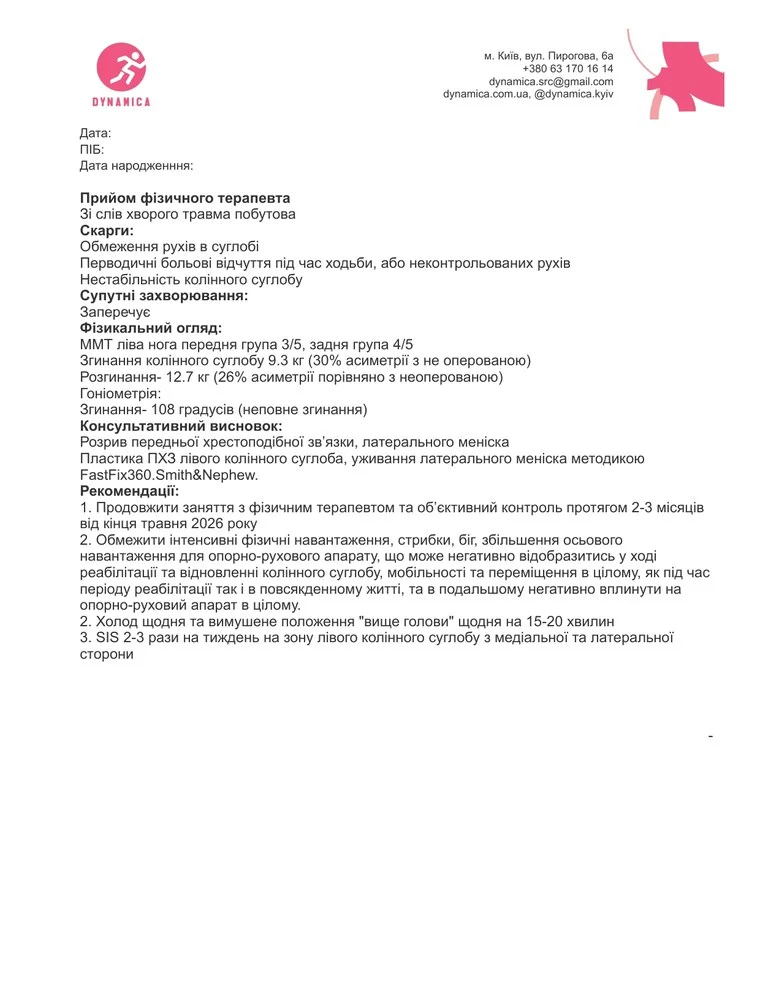
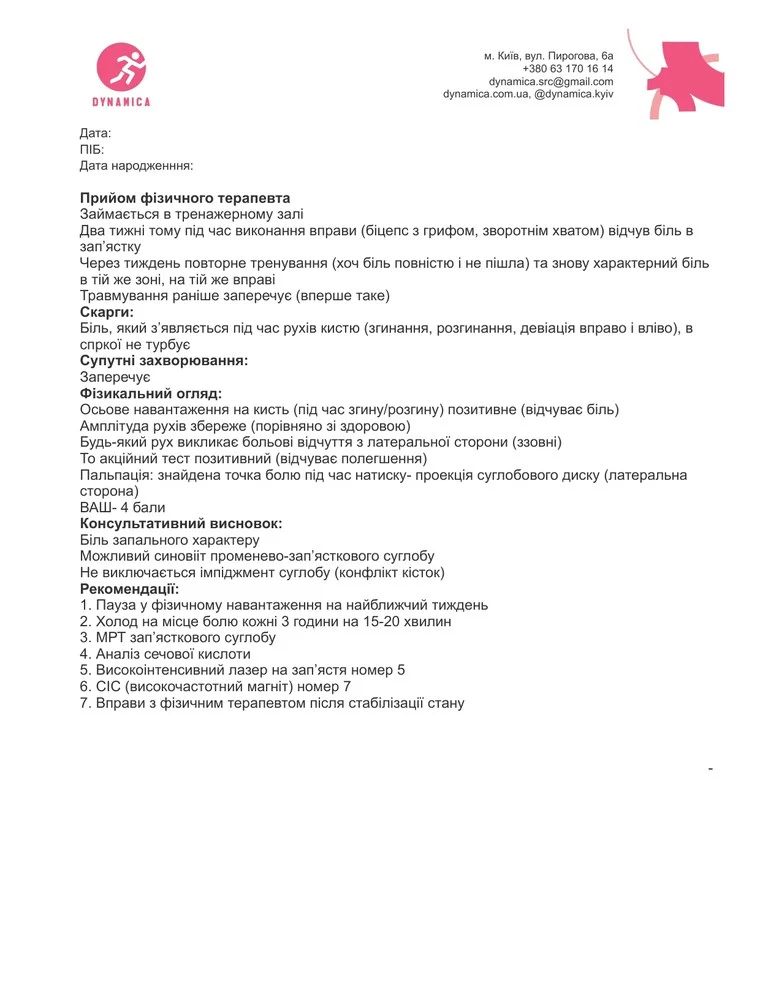
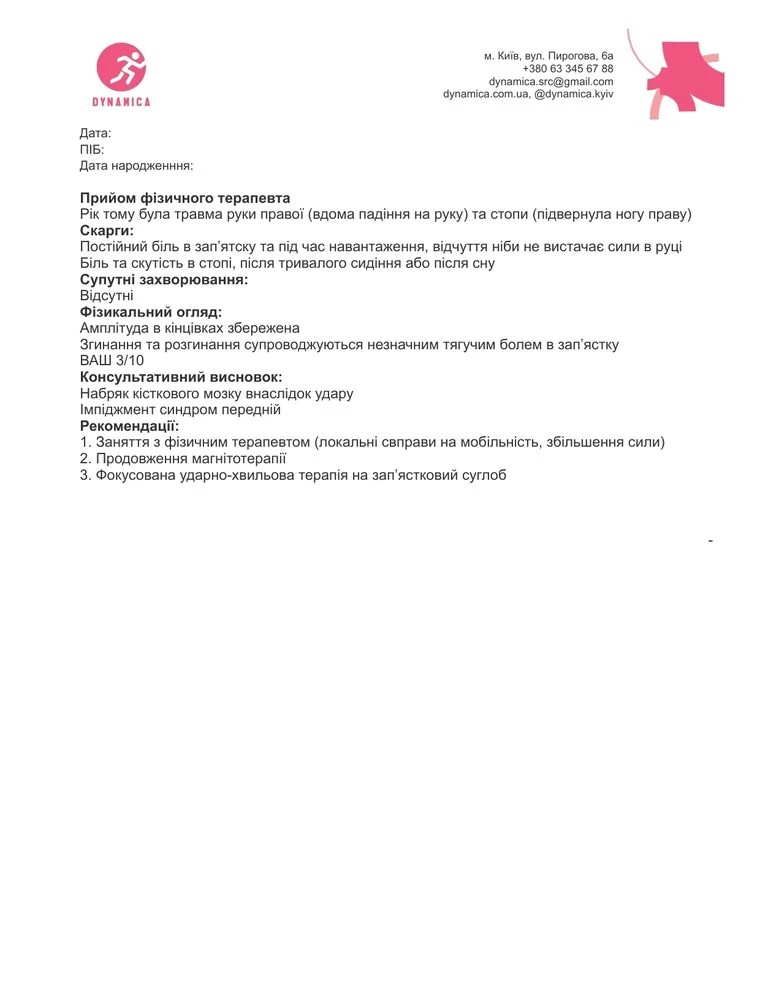
Real reports. Personal data hidden.
/ Recovery route
How we work:
from pain to strength
How long does it take? The first changes in movement control are noticeable within a few weeks. Strength and endurance are months of systematic work. We will be more precise after the assessment.
Stage 01 of 04 · REHAB
Rebuild the base
Reduce irritation and get weight-bearing back into the hand.
- We assess how the hand works under load.
- We unload the tendons and restore basic control.
- Physiotherapy — when pain needs to come down first.
Stage 02 of 04 · MOVE SAFE
Remove compensations
The problem is often not in the hand but higher up.
- We check how the forearm, elbow and shoulder work.
- We restore a stable movement pattern.
- We teach safe weight-bearing through the hand.
Stage 03 of 04 · MOVE SMART
Dose the load
The point is to change the load, not just mute the sign.
- We set the amount of work and the pauses.
- We go through your workstation and grip.
- We avoid flare-ups as training comes back.
Stage 04 of 04 · MOVE STRONG
Strength and endurance
The hand handles both work and sport.
- We rebuild grip strength.
- We restore endurance for static work.
- We fold it back into training and daily life.
/ Team
Who will work with you
The hand and wrist are handled by those who work with the whole upper limb.
 Valeriia CherniiRecovery specialistInjuries, arthrosis, chronic pain4 years+
 Denys SemerikRecovery specialistInjuries, training load, movement2 years+
 Daryna PopovaRecovery specialistBack, shoulders, knees, postnatal recovery4 years+
/ Physical therapy
What can help
you get there faster
Numbness and weakness in the fingers is no longer just tiredness. The equipment reduces swelling and irritation in the canal so we can work with movement.
This is not a separate course of procedures. Everything works inside the plan — and at the first visit it is included in the price.
Four tools. Which of them you actually need is decided by the physical therapist after the movement assessment.
/ Red flags
When you need a doctor examination
These signs mean you need a doctor first:
/ Reviews
What people say about us
“I have been coming to the center for almost 3 months and there is nothing bad to say about it.… The staff is always friendly, the center itself is clean and cozy, homey as they say.”
Олександра Кузьменкоafter an injury“I have been in rehabilitation for 3 months after surgery.… A good atmosphere, the sessions are methodically well built.”
Yuriy Andriychukafter surgery“After knee joint surgery I went through rehabilitation at this center.… They professionally took me through a set of exercises and gave a whole list of recommendations.”
Evgen Mongolafter surgery“I had been to several rehab specialists after knee ligament surgery, but only here did they really help me recover.”
Валентина Липинскаяafter surgery
/ First step
If it goes numb or hurts —
start with an assessment
The assessment will show what exactly is being overloaded and why. The movement assessment does not commit you to further work.
Movement assessment — UAH 2,000 · sessions after that UAH 1,500
/ Questions and answers
Frequent questions
I have carpal tunnel syndrome. Is surgery the only option?+
Not necessarily. At early and moderate stages many cases are managed conservatively. What decides is the state of the nerve and how much time has passed — we will assess and tell you honestly.
Why does it go numb specifically at night?+
At night the wrist stays bent for a long time and pressure inside the canal rises. That is why night numbness is often the first sign, and it is also the first to respond to work.
I just work at a computer a lot+
That is the most common cause. A long static posture overloads no less than sport does — different mechanism, same approach.
Do I need a brace?+
Sometimes for the night — it takes the load off and helps the signs. But a brace does not change how you use your hand during the day.
I carry a child in my arms, will this pass on its own?+
While the load is daily — rarely. But it can be redistributed and what is missing can be strengthened, without giving up carrying your child.

/ Who is responsible for this area
Reviewed by Valeriia Cherniiphysical therapistBogomolets National Medical University · injuries, arthrosis, chronic pain · BTL-Ukraine schoolSpecialist profile →19 September 2026