/ Where it hurts
Does your shoulder hurt?
It is not always “a tear”. We will bring movement control back.
We work step by step — from removing pain to building strength, under medical supervision.
Leave your number — then pick what suits you: Telegram or a call. No commitment.
/ Signs
What people come in
complaining about
Pain when raising the arm
hard to reach a shelf or comb your hair.
Pain when pressing and doing pull-ups
the load became unavailable.
Night pain
you cannot lie on that side.
After training
shows up the next day.
After a dislocation
the shoulder popped out — and you keep waiting for it.
Clicking and weakness
the arm does not hold weight the way it used to.
/ What it means
If your MRI says
“rotator cuff”
You read “partial tear”, “impingement” — and fear appears. We know that state.
- not every change on an MRI means surgery
- what matters is assessing joint function under load — that is what determines the strategy
- we do not replace surgery where it is needed
- but we often help avoid it
- there is an orthopedic trauma surgeon on the team — we review MRIs and ultrasounds together
An image shows structure. Decisions are made by function.
/ Who it is for
This is for you if…
- you cannot sleep on that side
- the arm does not go as high as it used to — and you have gotten used to it
- you stopped pressing and doing pull-ups “so as not to disturb it”
- the shoulder popped out once, and you keep waiting for it to happen again
- it hurts after the computer, not after sport
- you were offered surgery and want to try without it first
People who come to us are not athletes — they are people who want to move, sleep and sit normally without pain.
/ The cause
Why the shoulder hurts
in reality
The shoulder is one of the most mobile joints in the body.
Its stability depends on muscles, the shoulder blade and the thoracic spine.
So the problem is often not in the cuff but in how the whole shoulder girdle works: tendon overload, loss of stability, poor coordination, compensations after an old injury. We assess the whole girdle, not just the painful spot.
What happens,if you do nothing
When the shoulder hurts, the body adapts: you change the range, bring in other muscles, avoid painful positions. At first this reduces the pain. But over time other structures get overloaded — and the problem becomes chronic.
/ First visit
What happens at the first visit
It will not hurt. This is not about enduring, it is about understanding your movement — 90 minutes at a comfortable pace, and you leave with a plan.
We check joint mobility and muscle strength, palpate the area you complain about, take your history and run functional tests.
We try the first exercises and watch how your body responds — without sharp pain.
What exactly is holding the pain, which movement patterns are off, and a clear route forward. No pushing.
/ Proof
What you take
at the first visit
Not an opinion “in words”, but a written report: complaints, examination data in numbers, a conclusion and recommendations. Here are three real ones — different cases.
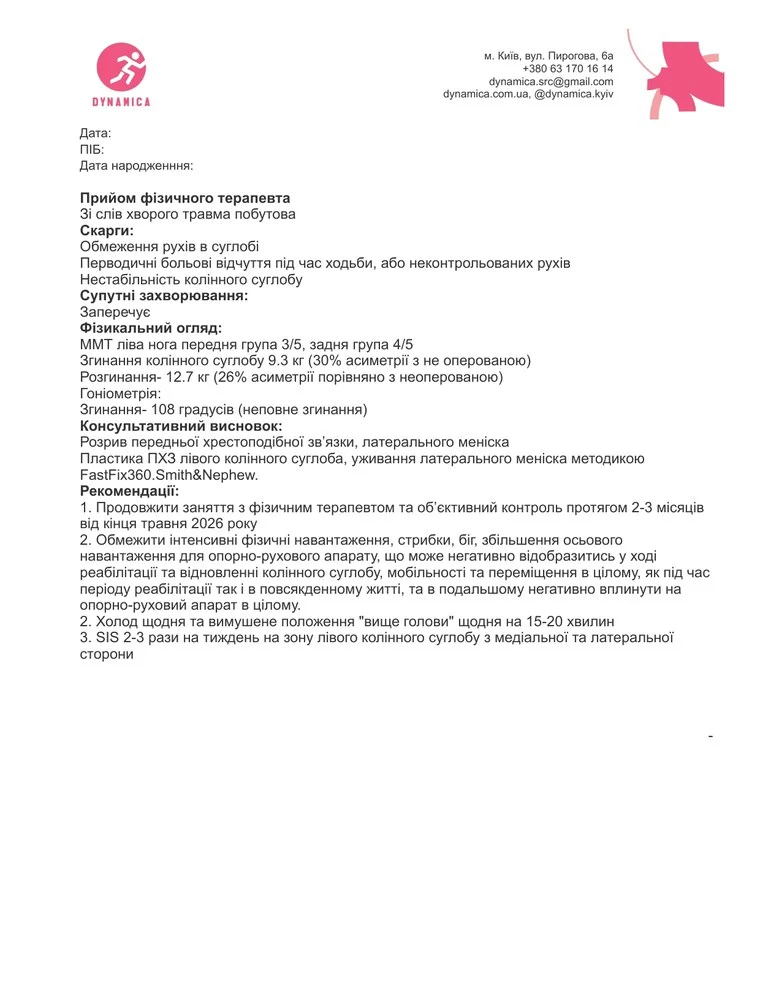
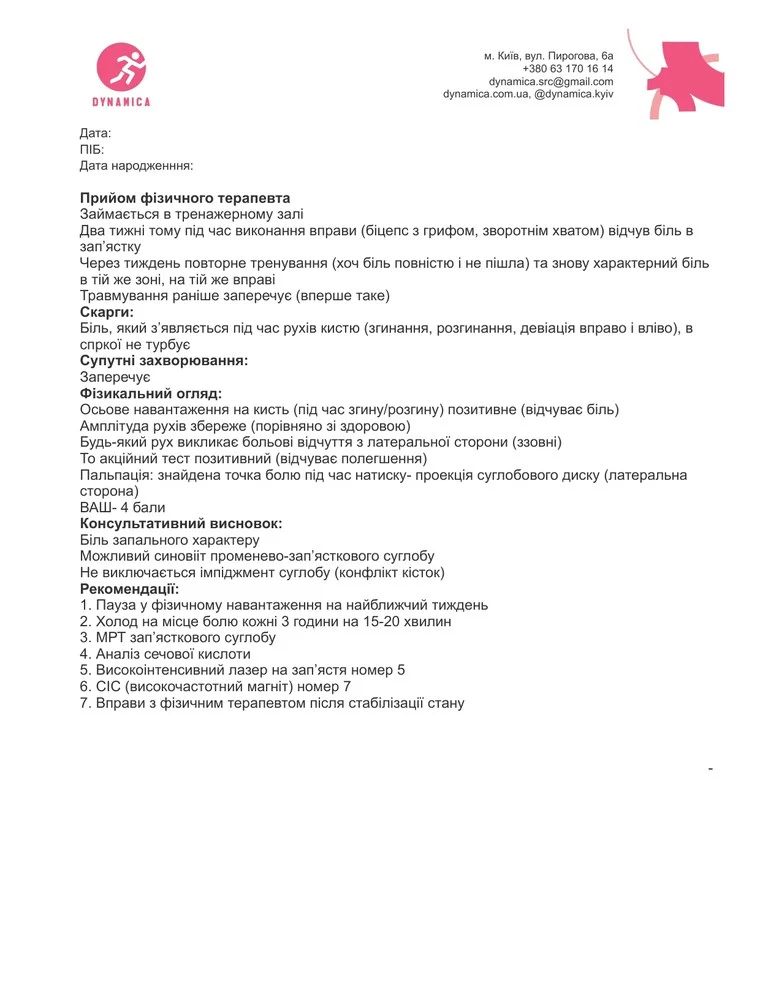
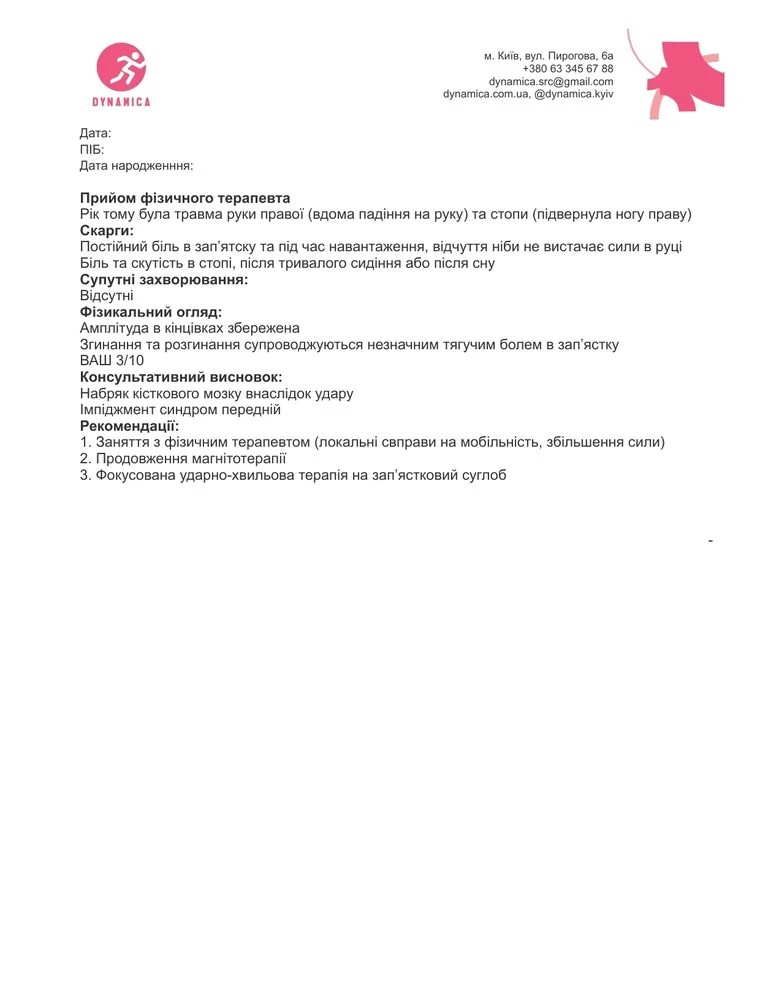
Real reports. Personal data hidden.
/ Recovery route
How we work:
from pain to strength
How long does it take? The first changes in movement control are noticeable within a few weeks. Strength and endurance are months of systematic work. We will be more precise after the assessment.
Stage 01 of 04 · REHAB
Take the load off
First — settle the tendon reaction.
- We assess the cuff and how the scapula works under load.
- We adjust the amount of load rather than removing sport altogether.
- Physiotherapy where indicated — to keep pain under control.
Stage 02 of 04 · MOVE SAFE
Scapular stability
The shoulder is held by a system, not by the joint alone.
- We restore thoracic mobility.
- We stabilise the scapula and switch on the deep stabilisers.
- We remove shoulder-girdle compensations.
Stage 03 of 04 · MOVE SMART
Strength and coordination
Tendons are rebuilt by load, not by rest.
- Isometric and eccentric protocols — where indicated.
- We work through pressing, pulling and pull-up technique.
- We build volume to a plan, with reassessment.
Stage 04 of 04 · MOVE STRONG
Full load
The shoulder is ready for your sport.
- Return to the gym, tennis, swimming, CrossFit.
- A margin for sharp and maximal movements.
- Preventing the next flare-up.
/ Team
Who will work with you
The shoulder is handled by those who work with tendons and getting people back to the gym.
 Valeriia CherniiRecovery specialistInjuries, arthrosis, chronic pain4 years+
 Daryna PopovaRecovery specialistBack, shoulders, knees, postnatal recovery4 years+
 Denys SemerikRecovery specialistInjuries, training load, movement2 years+
/ Physical therapy
What can help
you get there faster
The shoulder often hurts at night — and then neither sleep nor training works. The equipment brings down inflammation and pain so we can start loading the tendon in measured doses.
This is not a separate course of procedures. Everything works inside the plan — and at the first visit it is included in the price.
Five tools. Which of them you actually need is decided by the physical therapist after the movement assessment.
/ Red flags
When you need a doctor examination
These signs mean you need a doctor first:
/ Reviews
What people say about us
“I have old shoulder and knee injuries and decided it was time to do something about them. I am going through rehabilitation here now, and after a month the results are already noticeable.”
Yk Bckknee“It was love at first sight with Dynamica. I came here in the second year after multiple comminuted fractures (shoulder, heel) and, since I had experience with other rehab specialists before, I have something to compare it with.”
Yuliia Ternovashoulder“I am going through rehabilitation for a shoulder injury at this center. Very comfortable conditions and competent specialists.”
Victoria Svitlychnashoulder“I am a coach myself, and before an important sporting event I pulled my shoulder! They brought me back in 1.5 weeks of procedures, and afterwards I could move freely — even though I came in with pain so bad I could not raise my arm!”
Ганна Івахноshoulder
/ First step
If your shoulder hurts —
start with an assessment
The assessment will show what exactly is being overloaded and why. The movement assessment does not commit you to further work.
Movement assessment — UAH 2,000 · sessions after that UAH 1,500
/ Questions and answers
Frequent questions
I was told I need rotator cuff surgery+
Partial tears are often managed conservatively. What decides is not the image but function under load. We will assess and tell you honestly whether we see room without surgery — and if not, we will prepare you for it.
Why does it hurt specifically at night?+
At night muscular support disappears and pressure on irritated structures rises. This is a typical complaint with rotator cuff problems — and usually one of the first signs to go once work begins.
Can I keep training?+
In most cases yes, but with a changed set of exercises. We do not ban the gym — we remove what is harmful right now and add what is missing.
My shoulder popped out. Is that forever?+
After a dislocation the risk of recurrence is real, but it drops substantially once strength and shoulder blade control are restored. That is exactly what we work with.
How long will it take?+
The shoulder recovers more slowly than many other areas — that is normal. We give an exact forecast after the assessment, with intermediate checkpoints.
I have an “office” shoulder, no sport. Should I come too?+
Yes. A long static posture overloads the shoulder girdle no less than pressing does. Different mechanism, same approach.

/ Who is responsible for this area
Reviewed by Valeriia Cherniiphysical therapistBogomolets National Medical University · injuries, arthrosis, chronic pain · BTL-Ukraine schoolSpecialist profile →19 September 2026