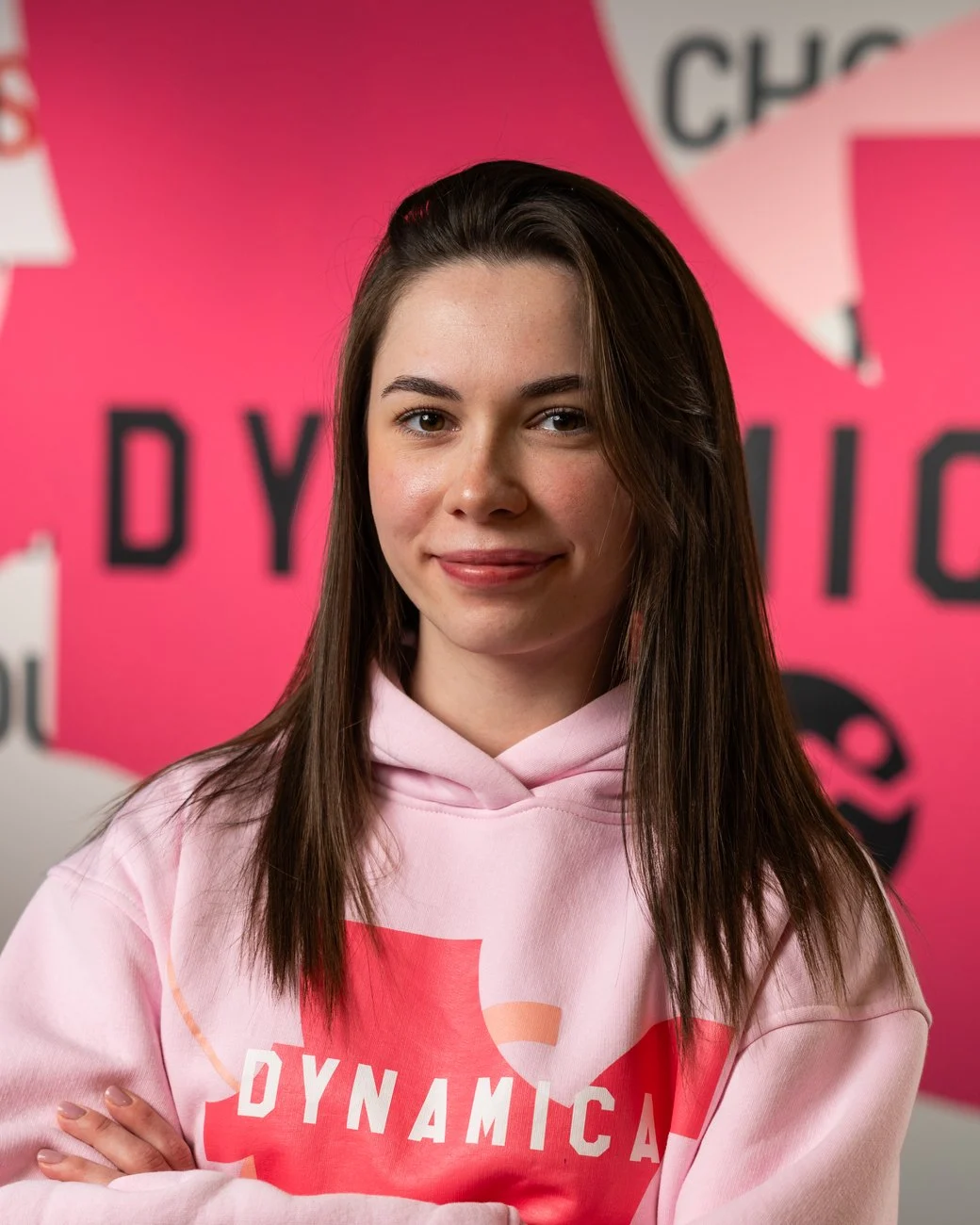
/ Team
CHERNII
VALERIIA
Physical therapist
Guides recovery after injuries and surgery, works with osteoarthritis and chronic back and neck pain.
The first visit is a movement assessment, not a prescription of procedures. Consultation UAH 2,000, no prepaid packages.
/ What people come with
DIFFERENT STORIES,
ONE LOGIC OF RECOVERY
Valeriia takes a person from the acute stage to returning to full load. The route follows one logic but fits a specific body: first we measure what exactly is not working, then we remove the cause rather than the sign.
- Injuries — fractures, dislocations, sprains, ligament tears
- After surgery — orthopedic and neurosurgical procedures, joint replacement
- Osteoarthritis and arthritis — when a joint has hurt for years and «nothing helps»
- Chronic back and neck pain — the kind that returns after every quiet spell
- Neurology — neuropathies, recovery after a stroke
/ Reviews
SEVENTEEN REVIEWS
CALL HER BY NAME
All seventeen are from 2026, all five stars. This is an export from our Google profile — we did not order them and did not edit them; the button to the profile is below. We also counted what exactly people thank her for.
- 9 of 17Write about the result: «I walk again», «I got back to sport», «she put me back on my feet»
- 5 of 17Note her attentiveness and tact — not speed, but the way she talked with them
- 4 of 17Say she found the cause and built a working plan when nothing had worked before
- 4 of 17Separately mention how the load was tailored to them
«I had a bad heel fracture. We started working with Lera: we discussed the training and treatment program, and the diet. The result is simply stunning — I already walk 3–4 km. Thank you Dynamica and Lera for a second life.»
Костя ДжулякInjuries«I highly recommend Valeriia as a specialist. She is the third doctor I consulted, and the one who managed to find the root of the problem and build a working treatment plan.»
Nataly DovzhenkoChronic pain«I especially want to thank Valeriia. You helped me get my fitness back after many injuries and return to sport!»
Oleksandr LevchukInjuries«I want to thank the rehabilitation specialist Valeriia separately — a true professional who pays close attention to every detail and helps achieve real progress.»
Олександр СеменченкоAfter surgery«Very grateful to physical therapist Valeriia for her approach, understanding and empathy — the best specialist!»
Татьяна МостоваяChronic pain«Special thanks to Valeriia — she literally gets you back on your feet.»
Vova RomanchukInjuries/ Path
SIX YEARS OF UNIVERSITY
AND FOUR YEARS OF PRACTICE
Not a weekend course but the full path: a bachelor’s and a master’s at the department of physical rehabilitation and sports medicine, with practice running alongside the studies.
- 2020 — 2024
Bachelor’s — Bogomolets NMU
Specialist in physical rehabilitation, assistant physical and occupational therapist. Department of physical rehabilitation and sports medicine.
- 2022 — 2023
Harmony of Health medical center
Individual and group rehabilitation sessions, functional testing, work with BTL physiotherapy equipment.
- 2023 — 2025
Liberi Studio sports rehabilitation studio
Consultations, initial and follow-up assessment, designing individual physical therapy programs, guiding recovery at every stage.
- 2024
Lectures for medical university students
On the use of BTL equipment in rehabilitation — the same equipment our center works with.
- 2024 — 2026
Master’s — Bogomolets NMU
Physical therapist. Degree with honours.
- since 2026
Dynamica — movement lab
Runs the full cycle: from the first movement assessment to the return to full load.
- BTL-Ukraine school — physiotherapy equipment
- Functional training
- Neuromuscular disorders of the lower limb
- International conference «Strategic directions of education and rehabilitation under martial law»
/ Outside the clinic
DANCED FOR ELEVEN YEARS,
STARTED AT FIVE
A feel for biomechanics — balance, coordination, the way the body distributes weight — came to her long before university. First it was dance, and only then anatomy in a textbook.
Today Valeriia runs, enters obstacle races, trains in the gym and keeps trying new sports. Someone who loads their own body every week finds it easier to explain what is happening with yours.
«Activity is not about exhaustion or routine — it is about freedom, ease and confidence»
Valeriia, on her work/ First visit
WHAT HAPPENS
AT THE FIRST VISIT
One hour. No prepaid packages, no promises of «three sessions» and no procedures prescribed before it is clear what exactly is not working.
- A conversation: what hurts, when it started, what you have already tried
- Movement assessment — how the body distributes weight and where it loses control
- Functional tests and, if needed, work on BTL equipment
- A written report and a plan: what we do next, how long it takes, what it costs
«She is the third doctor I consulted, and the one who managed to find the root of the problem and build a working treatment plan»
Nataly Dovzhenko · Google review/ The written report
THIS IS WHAT
THE REPORT LOOKS LIKE
Three real reports by our physical therapists — anonymised, with the clients’ permission. These are examples of what you receive after the first visit: not a prescription and not a label, but a clear description of what is happening with movement and what we do next.
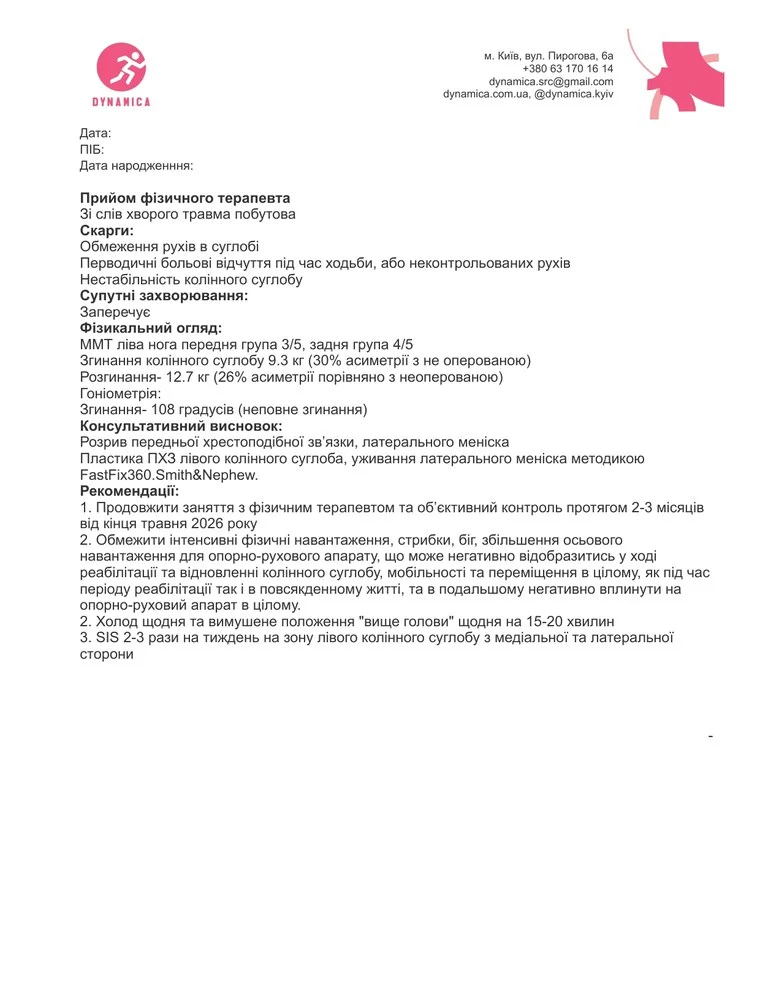
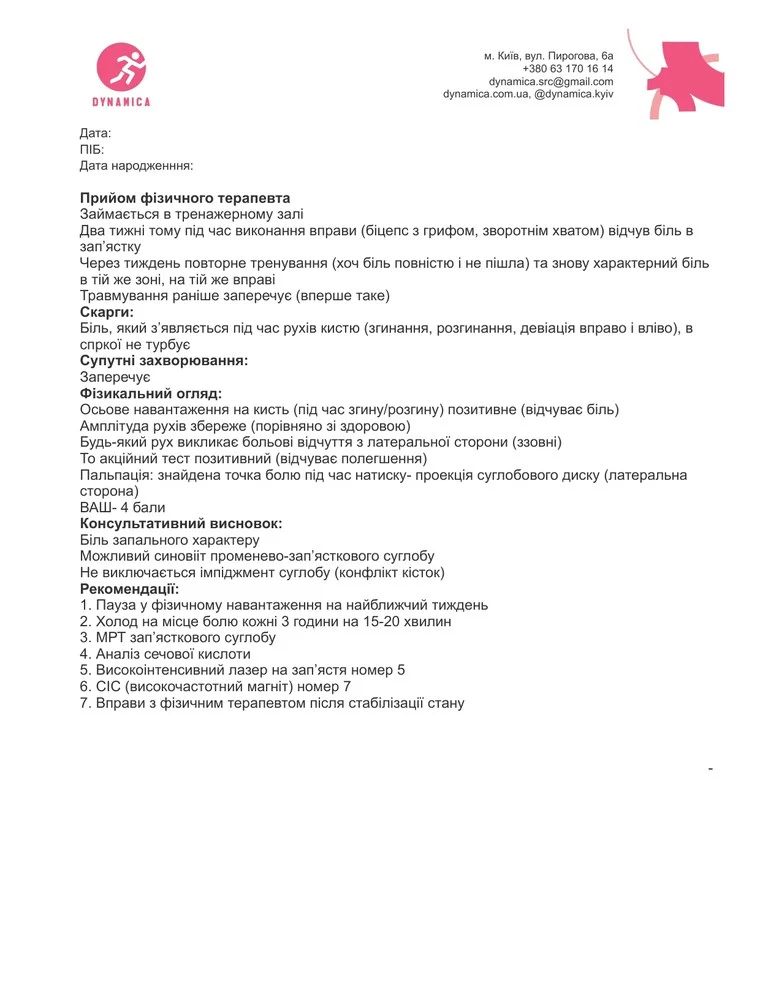
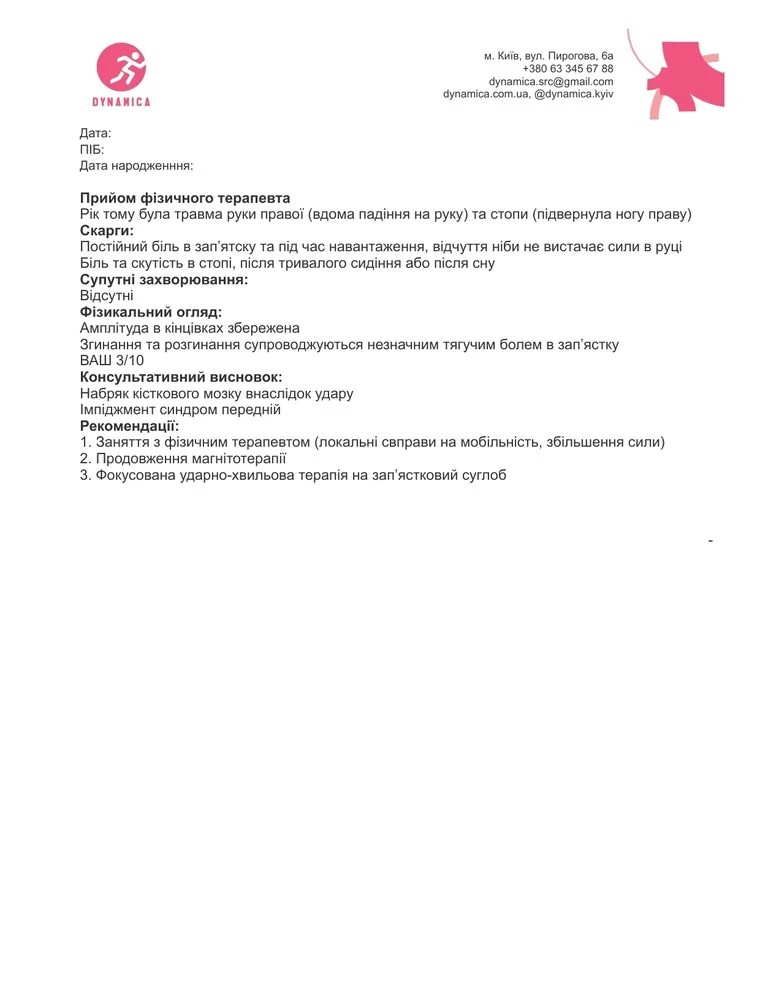
Real reports. Personal data hidden.
/ First step
START WITH A MOVEMENT ASSESSMENT,
NOT WITH A DIAGNOSIS
At the first meeting Valeriia watches how you move and decides with you what happens next.
Physical therapist consultation — UAH 2,000
/ Questions
What people ask most
The questions Valeriia hears at almost every consultation. The answers are in her words.
Will I definitely get back to training — and how fast?+
Getting back — almost always. The question is not whether you can, but in what volume and on what terms. The speed depends on what exactly is damaged, how much time has passed and what you did before coming to me. After testing I will tell you honestly: what I see either allows planning the return, or means we build the base first.
Have you had cases like mine before?+
Almost always — after surgery, sports injuries, fractures. But I do not treat you «like the previous similar one»: two identical diagnoses come with two different bodies, different ages, different training histories. The plan will be yours.
I am afraid to move after surgery — what if I do damage?+
Fear after surgery is normal, and it slows recovery more often than the injury itself. So we do not «grit our teeth and push»: we move within limits I control — first what is safe under your protocol, then more. Doing damage with movement that is selected and dosed is far harder than not moving for months.
Can surgery be avoided?+
That is the doctor’s decision and I do not replace it. What I can do is test you, give numbers and describe honestly what works now and what does not. With that you go to the doctor and decide with your eyes open. There are cases managed conservatively with success, and cases where delay only spoils the outcome of surgery.
Could exercise make it worse?+
From properly selected ones — no. From «read it online and did a thousand reps» — it can. The whole difference is dosage: I match the load to your condition and change it when the condition changes, rather than handing out a universal routine for all occasions.
Give me a timeline to full recovery+
Honestly: no one who has not tested you can name exact timelines in advance. After the first meeting I will give a benchmark and tell you what shifts it — whether you do the exercises at home, whether you sleep enough, whether there are related problems. «No miracles in a day» is a phrase I repeat to almost everyone.
And if I do exercises and procedures every day, will it be faster?+
No. Tissue recovers in the pauses between loads, not during them — daily «more» leads to a setback more often than to speed. Each procedure has its own frequency: magnetic therapy or pressotherapy can be daily, shockwave once every 3–5 days. I will write out the schedule, and it is part of the treatment too.
Will the pain be with me forever now?+
In most cases — no. Chronic pain takes longer than a fresh injury, and the honest goal here is not «zero forever» but a managed state: you know what triggers it, what to do about it and how to avoid a flare-up. For many people it simply stops being a topic after that.
Why does my joint keep clicking?+
The sound on its own is not a diagnosis. Clicking without pain, swelling or restricted movement usually means the joint is working normally. What is concerning is different: clicking that comes with pain, appeared after an injury or is accompanied by a sense of the joint locking — then we look closely.
Why do I need physiotherapy procedures and what are they?+
They do not replace working through movement — they make it possible to start. Magnetic therapy, laser and tecar take away pain and swelling, shockwave works on the tendon: when it hurts less you perform the exercise properly instead of compensating with other muscles. On their own, procedures have never rehabilitated anyone; combined with the work, they speed it up. More on physiotherapy equipment.